
Surgical Retractors
Retractors hold tissue, organs, and incision edges out of the way so surgeons can see and work safely in the operative field. This category features reusable, latex-free retractors from Aspen Surgical for general, abdominal, orthopedic, spine, neurological, thoracic, gynecologic, and ENT procedures. You will find hand-held Deaver, ribbon, and Children's Hospital retractors, self-retaining Weitlaner and Gelpi designs, Hohmann and Cobra orthopedic retractors, Cloward and Caspar cervical spine instruments, the Finochietto rib spreader, nasal specula, and a full range of Bookwalter table-mounted retractor components. Operating rooms, ambulatory surgery centers, and specialty surgical teams can find both complete systems and individual blades.
Why Retractors Are Essential
Surgery depends on exposure. If the surgeon cannot see the anatomy clearly, every step takes longer and the risk of injury to nearby structures rises. Retractors create and hold that working space, gently moving skin, muscle, organs, or bone aside so the target stays in view.
They also take pressure off the surgical team. Self-retaining and table-mounted retractors hold position on their own, freeing assistants' hands and reducing the fatigue that comes from holding a hand-held retractor through a long case. Steady, well-placed retraction can also be gentler on tissue than repeated repositioning. For patients, that means a procedure performed with better visibility and steadier technique. For staff, it means a calmer field and fewer hands crowded around the incision.
What Are Retractors?
A retractor is a surgical instrument used to separate the edges of an incision or hold back tissue and organs. Retractors fall into three broad groups. Hand-held retractors are held by an assistant. Self-retaining retractors use a ratchet or spring mechanism to stay open on their own. Table-mounted systems attach to the operating table and support multiple blades from a fixed frame.
Most retractors in this category are reusable stainless steel. Blades may be smooth, malleable, toothed, pronged, or fenestrated, and some Bookwalter blades are made of radiolucent titanium.
Types of Retractors
1. Hand-Held General Surgery Retractors
Best for: Abdominal, thyroid, and general surgery where an assistant can adjust retraction as the case progresses.
Hand-held retractors give the surgical team flexible, moment-to-moment control over exposure. The Deaver retractor has a smooth, curved blade suited to deep abdominal retraction and is offered here in several numbered sizes. The ribbon retractor is a malleable, double-ended blade (1 in. x 10 in.) that can be bent to fit the anatomy.
The category also includes the Children's Hospital retractor, the Green thyroid retractor with fenestrated blades, the Volkman sharp 4-prong rake retractor, the Aspen House hand retractor, and Carroll and Adson skin and dissecting hooks for fine tissue handling.
Key Features
- Smooth, curved Deaver blades are sized for different depths.
- Malleable ribbon blades can be shaped to fit the field.
- Pronged and hook designs grip skin and tissue edges.
- Fenestrated thyroid blades are designed for neck procedures.
Applications
- Abdominal and general surgery exposure.
- Thyroid and neck procedures.
- Retracting skin edges and superficial tissue.
- Protecting bowel and other organs during deep work.
2. Self-Retaining Retractors
Best for: Smaller incisions where steady, hands-free retraction is helpful.
Self-retaining retractors open and lock in place, holding the incision apart without an assistant. The Weitlaner retractor has opposing pronged arms and a ratchet and is offered here with sharp 3 x 4 prongs at 7 2/3 in. and blunt 3 x 4 prongs at 5 1/2 in. The Gelpi perineal retractor uses single pointed tips for deep, narrow exposure, and the Seletz-Gelpi laminectomy retractor adapts that design for spine work.
Key Features
- Ratchet mechanisms hold the retractor open without assistance.
- Sharp prongs offer a firm grip, and blunt prongs are gentler on tissue.
- A compact profile suits small and medium incisions.
Applications
- Orthopedic and soft tissue procedures.
- Perineal and general surgery.
- Laminectomy and other spine procedures.
3. Bookwalter Table-Mounted Retractor Systems
Best for: Major abdominal, pelvic, and gynecologic surgery that needs wide, stable exposure for long periods.
The Bookwalter system attaches to the operating table and holds multiple blades from a ring frame. Ratchet mechanisms let surgeons set each blade's position and tension independently.
This category offers the components to build or expand a Bookwalter setup: the Bookwalter Retractor Kit II, a retractor tray with Versapak table fixation, medium segmented rings, Violi post holders, lightweight post couplings, and standard, tilt, and Rotilt ratchet mechanisms. Blade options include Kelly blades, Magrina Deaver blades for gynecology, malleable blades, and radiolucent titanium blades in 4 in., 5 in., and 6 in. lengths.
Key Features
- Table fixation provides stable, hands-free exposure.
- Interchangeable blades can be positioned independently around the ring.
- Tilt and Rotilt ratchets allow multidirectional blade angling.
- Radiolucent titanium blades are designed for cases that use intraoperative imaging.
Applications
- Open abdominal and colorectal surgery.
- Gynecologic oncology and pelvic procedures.
- Long cases where steady retraction reduces assistant fatigue.
4. Orthopedic Retractors
Best for: Exposing bone and joints during orthopedic procedures.
Orthopedic retractors are built to lever soft tissue away from bone. The Hohmann retractor has a narrow tip that hooks around bone, with a broader blade behind it to hold muscle back. Options in this category include 22 mm and 24 mm widths, some with a finger ring handle for added control. The Cobra blunt retractor, at 10 1/4 in., has a wide, curved blade often used around joints.
Key Features
- Hohmann tips are designed to seat around bone for leverage.
- Finger ring handles improve grip and control.
- The wide, blunt Cobra blade helps protect surrounding soft tissue.
Applications
- Hip and knee procedures.
- Fracture exposure and fixation.
- General orthopedic soft tissue retraction.
5. Spine and Cervical Retractors and Distractors
Best for: Anterior cervical, lumbar, and other spine procedures.
Spine surgery needs retraction that holds a narrow corridor open while protecting nearby structures. This category includes the Cloward cervical retractor and Cloward blade retractors in several widths, the Symmetry Cloward cervical retractor with 7 blades, the Ultra Reveal cervical retractor, and the Ultra ACF Reveal distraction system instruments kit. The Aspen Caspar distractor and single-use distraction screws (12 mm and 14 mm deep) help support vertebral distraction.
For lumbar work, there is the Williams microlumbar retractor (70 mm x 10 mm blade, right or left), the Karlin spinal crank frame retractor, and the Adson retractor with sharp prongs and angular shaft. Cervical and Inge lamina spreaders are offered in adult and child sizes.
Key Features
- Multiple blade widths fit different spinal levels and patient sizes.
- Distraction systems help open the disc space during cervical procedures.
- Right and left microlumbar blades support unilateral approaches.
- Single-use distraction screws come sterile, 5 per box.
Applications
- Anterior cervical procedures.
- Microlumbar discectomy and laminectomy.
- Spinal procedures requiring vertebral distraction.
6. Neurosurgical Retractors
Best for: Delicate retraction around nerve roots, the dura, and cranial structures.
Neurosurgical retractors are smaller and finer, designed to hold delicate structures gently. The Scoville root retractor has a 90-degree angle and an 8 mm blade for nerve root retraction. The dural retractor (8 1/4 in.) is designed for retracting the dura, and the Miskimon cerebellar retractor is a self-retaining design for posterior fossa exposure.
Key Features
- Fine, angled blades are designed for tight spaces.
- Smooth surfaces help protect delicate neural tissue.
- A self-retaining cerebellar design provides steady exposure.
Applications
- Nerve root retraction during spine surgery.
- Dural retraction.
- Posterior fossa and cranial procedures.
7. Thoracic, ENT, and Specialty Retractors
Best for: Chest procedures, nasal and oral surgery, and other specialty exposure.
The Aspen Finochietto rib spreader (medium, 8 in.) uses a crank mechanism to spread the ribs for thoracic and cardiovascular access. For ENT procedures, the category includes the Cottle nasal speculum with 55 mm narrow tapered blades and the Killian septum speculum with 51 mm blades, both self-retaining, as well as the Davis mouth gag frame with a double bite. The Aspen Reddick-Saye screw retractor kit is a sterile, single-use kit with a 30 cm length.
Key Features
- A crank-operated rib spreader allows gradual, controlled opening.
- Self-retaining nasal specula hold the nasal passage open hands-free.
- Mouth gag frames hold the mouth open during oral and throat procedures.
Applications
- Thoracotomy and cardiovascular access.
- Septoplasty and nasal procedures.
- Tonsil and oral surgery.
When to Use Retractors
Retractors are used whenever a surgeon needs to create or maintain exposure. Typical situations include:
- Open abdominal and pelvic surgery: Bookwalter systems and Deaver retractors keep organs out of the field.
- Orthopedic procedures: Hohmann and Cobra retractors expose bone and joints.
- Spine and neurosurgery: Cervical, microlumbar, root, and dural retractors hold narrow corridors open.
- Thoracic surgery: Rib spreaders provide chest access.
- ENT and head and neck surgery: Nasal specula, mouth gags, and thyroid retractors.
- Superficial procedures: Skin hooks and small self-retaining retractors for minor surgery.
The surgeon chooses the retractor type and placement based on the procedure and the patient's anatomy.
How to Use Retractors
This is a general overview. Always follow facility protocol, clinical training, and manufacturer instructions.
- Prepare and inspect. Confirm the retractor is sterile and check for bent blades, loose parts, or ratchets that do not lock.
- Assemble systems in advance. For Bookwalter and other modular systems, confirm all rings, posts, ratchets, and blades are present.
- Place the blade gently. Position the blade on the tissue to be retracted, avoiding sharp prongs near delicate structures.
- Apply steady, appropriate tension. Use only as much force as needed for exposure.
- Reassess during the case. Check retracted tissue periodically and reposition as the surgeon directs.
- Reprocess after use. Disassemble, clean, and sterilize reusable components; discard single-use items per facility protocol.
Key Features of Retractors
- Hand-held, self-retaining, and table-mounted designs: Choose the level of hands-free support the case requires.
- Specialty blade shapes: Curved, malleable, pronged, angled, and fenestrated blades are tailored to specific anatomy.
- Modular Bookwalter components: Rings, posts, ratchets, and interchangeable blades let teams build the setup they need.
- Radiolucent titanium options: Select Bookwalter blades are made of radiolucent titanium.
- Reusable, latex-free construction: Most items are listed as reusable and latex-free, with select sterile single-use components.
Benefits of Retractors
1. Clear Visualization
Good retraction keeps the target anatomy in view. When the surgeon can see clearly, each step can proceed with greater confidence and less guesswork.
2. Protection for Surrounding Structures
Retractors hold nearby organs, vessels, and nerves away from the working area. Blunt and smooth blade options help reduce the chance of unintended contact with delicate tissue.
3. Hands-Free Exposure
Self-retaining and table-mounted retractors hold position on their own. That frees assistants to suction, irrigate, or pass instruments instead of holding a retractor for hours.
4. Reduced Team Fatigue
Long cases are physically demanding. Fixed retraction systems lighten the load on the surgical team, which helps everyone stay focused through the end of the procedure.
5. Adaptability Across Specialties
From a 5 1/2 in. Weitlaner to a full Bookwalter setup, the range in this category covers general surgery, orthopedics, spine, neurosurgery, thoracic, gynecology, and ENT, which lets departments standardize sourcing across service lines.
6. Long-Term Value
Reusable stainless steel retractors are designed for repeated reprocessing. Modular systems can be expanded one blade or ratchet at a time instead of replacing a full set.
How to Choose the Right Retractors
Begin with the procedure and specialty. Abdominal and pelvic cases often benefit from a Bookwalter system or Deaver retractors. Orthopedic teams typically need Hohmann and Cobra retractors. Spine and neurosurgery call for cervical, microlumbar, root, and dural retractors, and thoracic cases need a rib spreader.
Decide how much hands-free support you need. Hand-held retractors offer flexible, adjustable exposure but require an assistant. Self-retaining retractors suit smaller incisions. Table-mounted systems are best for large incisions and long cases.
Look at blade size and shape. Match blade width and depth to the incision and the patient's size. Malleable blades adapt to unusual anatomy, and pronged blades grip tissue edges firmly. Choose blunt prongs near delicate structures.
If you already use a Bookwalter system, confirm compatibility. Check that new blades, posts, and couplings match your ring and post size, such as the standard 1-in. system referenced in the post coupling listing. Finally, consider whether reusable or single-use components better fit your reprocessing workflow.
Frequently Asked Questions
1. What is the difference between hand-held and self-retaining retractors?
Hand-held retractors, such as Deaver and ribbon retractors, are held in place by an assistant and can be adjusted constantly. Self-retaining retractors, such as the Weitlaner and Gelpi, use a ratchet or locking mechanism to stay open on their own. Many procedures use both.
2. What is a Bookwalter retractor?
A Bookwalter retractor is a table-mounted system with a ring frame that holds multiple blades in fixed positions. Ratchet mechanisms let the surgeon adjust each blade independently. It is often used in large abdominal and pelvic procedures where wide, stable exposure is needed for an extended time.
3. Can I buy individual Bookwalter blades and parts?
Yes. This category includes individual Bookwalter blades, rings, post holders, couplings, and ratchet mechanisms, along with kits and trays. Before ordering, confirm that the parts match your existing system's specifications.
4. Why are some retractor blades radiolucent?
Radiolucent blades, such as the Bookwalter radiolucent titanium blades, are designed to reduce interference on intraoperative imaging, which can help when X-ray or fluoroscopy is used during the procedure.
5. When should I choose a sharp versus blunt retractor?
Sharp prongs grip tissue firmly and are useful for retracting skin, fascia, and dense tissue. Blunt prongs and smooth blades are gentler and generally preferred near vessels, nerves, and other delicate structures. The surgeon makes the final call based on the tissue involved.
6. Are these retractors reusable?
Most retractors in this category are listed as reusable and should be cleaned and sterilized between uses per facility protocol and manufacturer instructions. Some items, such as the distraction screws and the Reddick-Saye screw retractor kit, are sterile and single-use.
7. Are these retractors latex-free?
Most items in this category are listed as latex-free. Check the individual product listing to confirm for a specific retractor.
Related Products
Forceps: Tissue and dressing forceps work alongside retractors for grasping and manipulating tissue once exposure is established.
Surgical Scalpels & Blades: Stock scalpels and blades for the incisions that retractors will hold open.
Medical Scissors: Dissecting and suture scissors complete the core instrument set for most open procedures.
Fixation Devices for Surgery: Browse surgical fixation devices to round out supplies for orthopedic, spine, and general surgery teams.
Give your surgical team the exposure they need with Retractors from MedicalEx. Choose from hand-held Deaver and ribbon retractors, self-retaining Weitlaner and Gelpi designs, Hohmann orthopedic retractors, cervical and microlumbar spine instruments, and complete Bookwalter components from Aspen Surgical. Compare blade sizes and styles to fit your procedures, and explore our full range of Surgical Instruments to complete every tray.
-
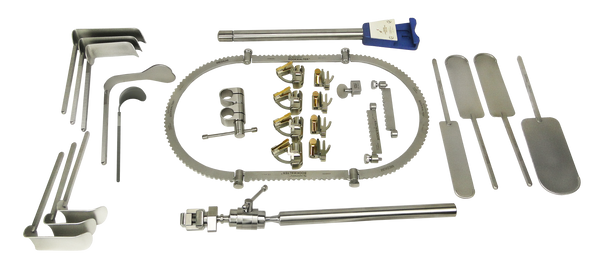
Aspen Bookwalter Retractor Kit III – Reusable Abdominal Retraction System, Latex-Free Construction
Aspen Surgical
$63,540.99Aspen Bookwalter Retractor Kit III is designed for surgical teams who demand reliable exposure during abdominal procedures. When you need steady, hands-free retraction, this system supports efficient...- SKU:
- 50-5710
- Latex-Free:
- Yes
$63,540.99 -


Ultra Reveal Cervical Retractor – Reusable Spine Retraction System, Latex-Free, For Surgical Use
Aspen Surgical
$64,756.99Ultra Reveal Cervical Retractor is designed for spine surgeons who need precise retraction during cervical procedures. This reusable system supports efficient surgical workflows and helps maintain a...- SKU:
- 59-4000
- Latex-Free:
- Yes
$64,756.99
About Surgical Retractors
Retractors hold tissue, organs, and incision edges out of the way so surgeons can see and work safely in the operative field. This category features reusable, latex-free retractors from Aspen Surgical for general, abdominal, orthopedic, spine, neurological, thoracic, gynecologic, and ENT procedures. You will find hand-held Deaver, ribbon, and Children's Hospital retractors, self-retaining Weitlaner and Gelpi designs, Hohmann and Cobra orthopedic retractors, Cloward and Caspar cervical spine instruments, the Finochietto rib spreader, nasal specula, and a full range of Bookwalter table-mounted retractor components. Operating rooms, ambulatory surgery centers, and specialty surgical teams can find both complete systems and individual blades.
Why Retractors Are Essential
Surgery depends on exposure. If the surgeon cannot see the anatomy clearly, every step takes longer and the risk of injury to nearby structures rises. Retractors create and hold that working space, gently moving skin, muscle, organs, or bone aside so the target stays in view.
They also take pressure off the surgical team. Self-retaining and table-mounted retractors hold position on their own, freeing assistants' hands and reducing the fatigue that comes from holding a hand-held retractor through a long case. Steady, well-placed retraction can also be gentler on tissue than repeated repositioning. For patients, that means a procedure performed with better visibility and steadier technique. For staff, it means a calmer field and fewer hands crowded around the incision.
What Are Retractors?
A retractor is a surgical instrument used to separate the edges of an incision or hold back tissue and organs. Retractors fall into three broad groups. Hand-held retractors are held by an assistant. Self-retaining retractors use a ratchet or spring mechanism to stay open on their own. Table-mounted systems attach to the operating table and support multiple blades from a fixed frame.
Most retractors in this category are reusable stainless steel. Blades may be smooth, malleable, toothed, pronged, or fenestrated, and some Bookwalter blades are made of radiolucent titanium.
Types of Retractors
1. Hand-Held General Surgery Retractors
Best for: Abdominal, thyroid, and general surgery where an assistant can adjust retraction as the case progresses.
Hand-held retractors give the surgical team flexible, moment-to-moment control over exposure. The Deaver retractor has a smooth, curved blade suited to deep abdominal retraction and is offered here in several numbered sizes. The ribbon retractor is a malleable, double-ended blade (1 in. x 10 in.) that can be bent to fit the anatomy.
The category also includes the Children's Hospital retractor, the Green thyroid retractor with fenestrated blades, the Volkman sharp 4-prong rake retractor, the Aspen House hand retractor, and Carroll and Adson skin and dissecting hooks for fine tissue handling.
Key Features
- Smooth, curved Deaver blades are sized for different depths.
- Malleable ribbon blades can be shaped to fit the field.
- Pronged and hook designs grip skin and tissue edges.
- Fenestrated thyroid blades are designed for neck procedures.
Applications
- Abdominal and general surgery exposure.
- Thyroid and neck procedures.
- Retracting skin edges and superficial tissue.
- Protecting bowel and other organs during deep work.
2. Self-Retaining Retractors
Best for: Smaller incisions where steady, hands-free retraction is helpful.
Self-retaining retractors open and lock in place, holding the incision apart without an assistant. The Weitlaner retractor has opposing pronged arms and a ratchet and is offered here with sharp 3 x 4 prongs at 7 2/3 in. and blunt 3 x 4 prongs at 5 1/2 in. The Gelpi perineal retractor uses single pointed tips for deep, narrow exposure, and the Seletz-Gelpi laminectomy retractor adapts that design for spine work.
Key Features
- Ratchet mechanisms hold the retractor open without assistance.
- Sharp prongs offer a firm grip, and blunt prongs are gentler on tissue.
- A compact profile suits small and medium incisions.
Applications
- Orthopedic and soft tissue procedures.
- Perineal and general surgery.
- Laminectomy and other spine procedures.
3. Bookwalter Table-Mounted Retractor Systems
Best for: Major abdominal, pelvic, and gynecologic surgery that needs wide, stable exposure for long periods.
The Bookwalter system attaches to the operating table and holds multiple blades from a ring frame. Ratchet mechanisms let surgeons set each blade's position and tension independently.
This category offers the components to build or expand a Bookwalter setup: the Bookwalter Retractor Kit II, a retractor tray with Versapak table fixation, medium segmented rings, Violi post holders, lightweight post couplings, and standard, tilt, and Rotilt ratchet mechanisms. Blade options include Kelly blades, Magrina Deaver blades for gynecology, malleable blades, and radiolucent titanium blades in 4 in., 5 in., and 6 in. lengths.
Key Features
- Table fixation provides stable, hands-free exposure.
- Interchangeable blades can be positioned independently around the ring.
- Tilt and Rotilt ratchets allow multidirectional blade angling.
- Radiolucent titanium blades are designed for cases that use intraoperative imaging.
Applications
- Open abdominal and colorectal surgery.
- Gynecologic oncology and pelvic procedures.
- Long cases where steady retraction reduces assistant fatigue.
4. Orthopedic Retractors
Best for: Exposing bone and joints during orthopedic procedures.
Orthopedic retractors are built to lever soft tissue away from bone. The Hohmann retractor has a narrow tip that hooks around bone, with a broader blade behind it to hold muscle back. Options in this category include 22 mm and 24 mm widths, some with a finger ring handle for added control. The Cobra blunt retractor, at 10 1/4 in., has a wide, curved blade often used around joints.
Key Features
- Hohmann tips are designed to seat around bone for leverage.
- Finger ring handles improve grip and control.
- The wide, blunt Cobra blade helps protect surrounding soft tissue.
Applications
- Hip and knee procedures.
- Fracture exposure and fixation.
- General orthopedic soft tissue retraction.
5. Spine and Cervical Retractors and Distractors
Best for: Anterior cervical, lumbar, and other spine procedures.
Spine surgery needs retraction that holds a narrow corridor open while protecting nearby structures. This category includes the Cloward cervical retractor and Cloward blade retractors in several widths, the Symmetry Cloward cervical retractor with 7 blades, the Ultra Reveal cervical retractor, and the Ultra ACF Reveal distraction system instruments kit. The Aspen Caspar distractor and single-use distraction screws (12 mm and 14 mm deep) help support vertebral distraction.
For lumbar work, there is the Williams microlumbar retractor (70 mm x 10 mm blade, right or left), the Karlin spinal crank frame retractor, and the Adson retractor with sharp prongs and angular shaft. Cervical and Inge lamina spreaders are offered in adult and child sizes.
Key Features
- Multiple blade widths fit different spinal levels and patient sizes.
- Distraction systems help open the disc space during cervical procedures.
- Right and left microlumbar blades support unilateral approaches.
- Single-use distraction screws come sterile, 5 per box.
Applications
- Anterior cervical procedures.
- Microlumbar discectomy and laminectomy.
- Spinal procedures requiring vertebral distraction.
6. Neurosurgical Retractors
Best for: Delicate retraction around nerve roots, the dura, and cranial structures.
Neurosurgical retractors are smaller and finer, designed to hold delicate structures gently. The Scoville root retractor has a 90-degree angle and an 8 mm blade for nerve root retraction. The dural retractor (8 1/4 in.) is designed for retracting the dura, and the Miskimon cerebellar retractor is a self-retaining design for posterior fossa exposure.
Key Features
- Fine, angled blades are designed for tight spaces.
- Smooth surfaces help protect delicate neural tissue.
- A self-retaining cerebellar design provides steady exposure.
Applications
- Nerve root retraction during spine surgery.
- Dural retraction.
- Posterior fossa and cranial procedures.
7. Thoracic, ENT, and Specialty Retractors
Best for: Chest procedures, nasal and oral surgery, and other specialty exposure.
The Aspen Finochietto rib spreader (medium, 8 in.) uses a crank mechanism to spread the ribs for thoracic and cardiovascular access. For ENT procedures, the category includes the Cottle nasal speculum with 55 mm narrow tapered blades and the Killian septum speculum with 51 mm blades, both self-retaining, as well as the Davis mouth gag frame with a double bite. The Aspen Reddick-Saye screw retractor kit is a sterile, single-use kit with a 30 cm length.
Key Features
- A crank-operated rib spreader allows gradual, controlled opening.
- Self-retaining nasal specula hold the nasal passage open hands-free.
- Mouth gag frames hold the mouth open during oral and throat procedures.
Applications
- Thoracotomy and cardiovascular access.
- Septoplasty and nasal procedures.
- Tonsil and oral surgery.
When to Use Retractors
Retractors are used whenever a surgeon needs to create or maintain exposure. Typical situations include:
- Open abdominal and pelvic surgery: Bookwalter systems and Deaver retractors keep organs out of the field.
- Orthopedic procedures: Hohmann and Cobra retractors expose bone and joints.
- Spine and neurosurgery: Cervical, microlumbar, root, and dural retractors hold narrow corridors open.
- Thoracic surgery: Rib spreaders provide chest access.
- ENT and head and neck surgery: Nasal specula, mouth gags, and thyroid retractors.
- Superficial procedures: Skin hooks and small self-retaining retractors for minor surgery.
The surgeon chooses the retractor type and placement based on the procedure and the patient's anatomy.
How to Use Retractors
This is a general overview. Always follow facility protocol, clinical training, and manufacturer instructions.
- Prepare and inspect. Confirm the retractor is sterile and check for bent blades, loose parts, or ratchets that do not lock.
- Assemble systems in advance. For Bookwalter and other modular systems, confirm all rings, posts, ratchets, and blades are present.
- Place the blade gently. Position the blade on the tissue to be retracted, avoiding sharp prongs near delicate structures.
- Apply steady, appropriate tension. Use only as much force as needed for exposure.
- Reassess during the case. Check retracted tissue periodically and reposition as the surgeon directs.
- Reprocess after use. Disassemble, clean, and sterilize reusable components; discard single-use items per facility protocol.
Key Features of Retractors
- Hand-held, self-retaining, and table-mounted designs: Choose the level of hands-free support the case requires.
- Specialty blade shapes: Curved, malleable, pronged, angled, and fenestrated blades are tailored to specific anatomy.
- Modular Bookwalter components: Rings, posts, ratchets, and interchangeable blades let teams build the setup they need.
- Radiolucent titanium options: Select Bookwalter blades are made of radiolucent titanium.
- Reusable, latex-free construction: Most items are listed as reusable and latex-free, with select sterile single-use components.
Benefits of Retractors
1. Clear Visualization
Good retraction keeps the target anatomy in view. When the surgeon can see clearly, each step can proceed with greater confidence and less guesswork.
2. Protection for Surrounding Structures
Retractors hold nearby organs, vessels, and nerves away from the working area. Blunt and smooth blade options help reduce the chance of unintended contact with delicate tissue.
3. Hands-Free Exposure
Self-retaining and table-mounted retractors hold position on their own. That frees assistants to suction, irrigate, or pass instruments instead of holding a retractor for hours.
4. Reduced Team Fatigue
Long cases are physically demanding. Fixed retraction systems lighten the load on the surgical team, which helps everyone stay focused through the end of the procedure.
5. Adaptability Across Specialties
From a 5 1/2 in. Weitlaner to a full Bookwalter setup, the range in this category covers general surgery, orthopedics, spine, neurosurgery, thoracic, gynecology, and ENT, which lets departments standardize sourcing across service lines.
6. Long-Term Value
Reusable stainless steel retractors are designed for repeated reprocessing. Modular systems can be expanded one blade or ratchet at a time instead of replacing a full set.
How to Choose the Right Retractors
Begin with the procedure and specialty. Abdominal and pelvic cases often benefit from a Bookwalter system or Deaver retractors. Orthopedic teams typically need Hohmann and Cobra retractors. Spine and neurosurgery call for cervical, microlumbar, root, and dural retractors, and thoracic cases need a rib spreader.
Decide how much hands-free support you need. Hand-held retractors offer flexible, adjustable exposure but require an assistant. Self-retaining retractors suit smaller incisions. Table-mounted systems are best for large incisions and long cases.
Look at blade size and shape. Match blade width and depth to the incision and the patient's size. Malleable blades adapt to unusual anatomy, and pronged blades grip tissue edges firmly. Choose blunt prongs near delicate structures.
If you already use a Bookwalter system, confirm compatibility. Check that new blades, posts, and couplings match your ring and post size, such as the standard 1-in. system referenced in the post coupling listing. Finally, consider whether reusable or single-use components better fit your reprocessing workflow.
Frequently Asked Questions
1. What is the difference between hand-held and self-retaining retractors?
Hand-held retractors, such as Deaver and ribbon retractors, are held in place by an assistant and can be adjusted constantly. Self-retaining retractors, such as the Weitlaner and Gelpi, use a ratchet or locking mechanism to stay open on their own. Many procedures use both.
2. What is a Bookwalter retractor?
A Bookwalter retractor is a table-mounted system with a ring frame that holds multiple blades in fixed positions. Ratchet mechanisms let the surgeon adjust each blade independently. It is often used in large abdominal and pelvic procedures where wide, stable exposure is needed for an extended time.
3. Can I buy individual Bookwalter blades and parts?
Yes. This category includes individual Bookwalter blades, rings, post holders, couplings, and ratchet mechanisms, along with kits and trays. Before ordering, confirm that the parts match your existing system's specifications.
4. Why are some retractor blades radiolucent?
Radiolucent blades, such as the Bookwalter radiolucent titanium blades, are designed to reduce interference on intraoperative imaging, which can help when X-ray or fluoroscopy is used during the procedure.
5. When should I choose a sharp versus blunt retractor?
Sharp prongs grip tissue firmly and are useful for retracting skin, fascia, and dense tissue. Blunt prongs and smooth blades are gentler and generally preferred near vessels, nerves, and other delicate structures. The surgeon makes the final call based on the tissue involved.
6. Are these retractors reusable?
Most retractors in this category are listed as reusable and should be cleaned and sterilized between uses per facility protocol and manufacturer instructions. Some items, such as the distraction screws and the Reddick-Saye screw retractor kit, are sterile and single-use.
7. Are these retractors latex-free?
Most items in this category are listed as latex-free. Check the individual product listing to confirm for a specific retractor.
Related Products
Forceps: Tissue and dressing forceps work alongside retractors for grasping and manipulating tissue once exposure is established.
Surgical Scalpels & Blades: Stock scalpels and blades for the incisions that retractors will hold open.
Medical Scissors: Dissecting and suture scissors complete the core instrument set for most open procedures.
Fixation Devices for Surgery: Browse surgical fixation devices to round out supplies for orthopedic, spine, and general surgery teams.
Give your surgical team the exposure they need with Retractors from MedicalEx. Choose from hand-held Deaver and ribbon retractors, self-retaining Weitlaner and Gelpi designs, Hohmann orthopedic retractors, cervical and microlumbar spine instruments, and complete Bookwalter components from Aspen Surgical. Compare blade sizes and styles to fit your procedures, and explore our full range of Surgical Instruments to complete every tray.