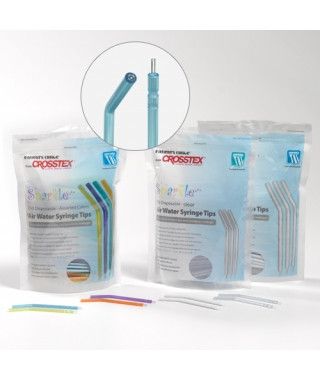
Description
The Microbrush Crystal Tip Disposable Air/Water Syringe Tips give dental teams a fresh, single-use tip for every patient, with air and water kept apart from the first spray to the last. When a hygienist reaches for the syringe dozens of times a day, a tip that seats like metal and sprays dry air on demand keeps the appointment moving and the field clear. Each tip goes straight from the bag to the syringe, then to the operatory waste after one use.
- Instant Dry Air – The quad air core delivers dry air on demand, so bonding and drying steps start without clearing water from the air line.
- Complete Air and Water Separation – The inner core seats through the syringe O-ring, so water stays in its own channel and out of the air stream.
- Bends and Holds Its Shape – Pliable plastic bends for hard-to-reach areas and keeps the bend through the procedure.
- Fresh Tip for Every Patient – Single-use tips remove the cleaning and sterilization cycle that metal tips demand between patients.
Air/Water Syringe Tips That Keep Air Dry and Water Separate
Crystal Tip built its name on one job: delivering air, water, and spray with no crossover between the two streams. The two-piece design sends water through an inner core while air travels through four channels in the outer core, and the translucent outer wall lets the clinician see at a glance if water ever enters the air chamber. Dental practices use these disposable dental syringe tips during cleanings, restorative work, and adhesive procedures where a dry field decides the quality of the result. The tip seats into standard USA and UK syringes the same way a metal tip does, so operatories switch without new hardware or retraining. For the clinician, that means a dry field on the first trigger pull and one less reprocessing chore at the end of the day.
Features and Benefits
Separation and Spray Control
- Quad Air Core Channels – Four air channels in the outer core build strong, even airflow and fine atomization when air and water spray together.
- Two-Piece Inner Core – The water core extends into the syringe and seals through the O-ring, the fit that keeps water out of the air channels.
- Translucent Outer Core – The clear outer wall shows any water that reaches the air chamber, so a worn O-ring is spotted before it affects a procedure.
Fit, Reach and Handling
- Bendable Tip Body – The pliable plastic bends straight, in a U, or with a double bend and holds that shape without narrowing the air or water path.
- Tip-Lock Groove – An O-ring notch locks the tip into the syringe and guards against accidental ejection mid-procedure.
- Beveled Smooth Ends – Beveled edges at both ends protect patient tissue during retraction and reduce wear on syringe O-rings.
- Direct Bottom Air Feed – Air enters from the syringe base rather than a side port, a straighter path that keeps air pressure strong at the tip.
Infection Control Workflow
- Single-Use Disposal – One tip serves one patient and is then discarded, cutting the cross-contamination risk that reprocessed tips carry.
- No Reprocessing Steps – Disposable tips skip cleaning, packaging, and autoclaving, returning staff time to patient care.
Product Specifications
Tip Design
- Construction: Two-piece plastic tip with inner water core and outer air core
- Air Channels: 4 (Quad Air Core)
- Tip Length: 95 mm
- Edges: Beveled at both ends
- Locking Feature: Tip-lock groove for the syringe O-ring
Fit and Use
- Syringe Fit: Standard USA and UK dental air/water syringes
- Adapter Required: None for standard syringes
- Use: Single use, disposable
- Country of Origin: USA
Configurations and Packaging
- Colors in This Listing: Classic Rainbow, Pacific Blue
- Packaging by Configuration: Classic Rainbow 250 per bag and 1500 per bag, Pacific Blue 250 per bag and 1500 per bag
Browse the full Dental Supplies range, or shop everything from Microbrush.
Why Practices Switch to Crystal Tip
Most disposable tips route air through a single open space around the water core, and spray quality varies with it. This design separates the air into four formed channels and seals the water core through the syringe O-ring, so separation and spray stay consistent from tip to tip. Practices that switch keep the familiar metal-tip fit while dropping the reprocessing routine entirely.
- Four Formed Air Channels – A defined quad air core replaces the single open air space of common tips, giving repeatable spray and atomization.
- Separation You Can See – The translucent outer core exposes any water crossover at a glance, so problems surface before they reach the patient.
- Metal-Tip Fit, Disposable Routine – The tip seats like the metal tip it replaces, then leaves with the operatory waste instead of the sterilizer load.
- Length for Back Molars – At 95 mm, the tip reaches posterior teeth and buccal or lingual surfaces that shorter tips strain to cover.
Frequently Asked Questions
Will these tips fit my air/water syringe?
The tips seat into standard USA and UK dental syringes the same way metal tips do, and the manufacturer names A-dec and DCI syringes as the fit the inner core was designed around. Syringes converted to a proprietary adapter system need that adapter removed or a matching adapter fitted to return the syringe to its standard format.
How do the tips keep air and water separate?
The inner core extends into the syringe and seals through the O-ring, carrying water in its own channel while air flows through the four outer channels. The translucent outer core also lets you see any water that enters the air chamber, which the manufacturer notes is most often a sign of a worn O-ring.
Can the tips be bent during a procedure?
Yes. The two-piece pliable plastic bends and holds its shape without closing off air or water flow, and the manufacturer describes straight, U-form, single, and double bends as supported positions for hard-to-reach areas.
Do the stems break off inside the syringe?
The two-piece construction gives the stem more strength than a single-piece molded tip, which is the design point the manufacturer raises against the breakage reported with one-piece tips. Correct insertion without twisting or bending during seating also protects the stem.
Why use disposable tips instead of metal tips?
A fresh tip for every patient removes cleaning and sterilization work, along with the clogging and loss that shorten metal tip life. Plastic also wears syringe O-rings more slowly than metal does, which protects the seal that keeps air and water apart.
How often should syringe O-rings be replaced?
The manufacturer advises replacing O-rings at least once a year, because worn O-rings are the most common cause of leakage and of tips seating poorly. Proper tip insertion is the other half of a reliable seal.