





Description
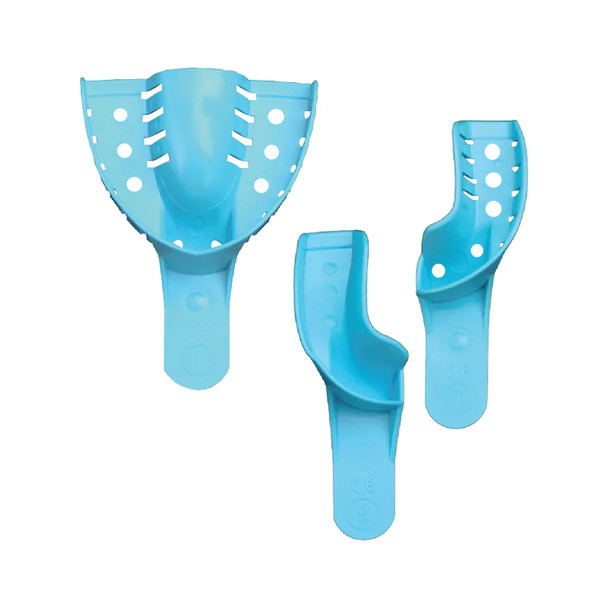
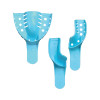
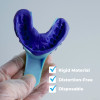
The Pac-Dent Opti-Tray Disposable Impression Trays are rigid, distortion-free trays molded from highly impact-resistant light blue plastic. Perforations are designed to enhance consistent flow and retention of impression material, and every tray is 100% latex-free.
- Rigid, distortion-free build – impact-resistant plastic holds the impression's shape from mouth to pour
- Retention perforations – perforated styles promote consistent material flow and lock-in
- Anatomically designed – smooth edges and shaped arches for patient comfort
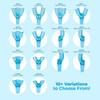
- Fourteen styles – full-arch sizes, anterior and quadrant trays, perforated and non-perforated
Rigid Disposable Trays in a Complete Size Range
A disposable tray has one job: stay rigid long enough for the impression to be poured accurately. These trays are molded from highly impact-resistant plastic that keeps them distortion-free, and the perforations in the standard styles are placed to encourage consistent flow and retention of the material. The shapes are anatomical with smooth edges, which patients notice during longer sets. Compatibility covers a wide variety of impression materials, so the same tray family serves alginate and elastomeric workflows alike. Fourteen styles span upper and lower arches in three sizes, anterior trays and quadrant trays in both perforated and non-perforated versions, all latex-free and packed 12 to a pack.
Features and Benefits
Tray Performance
- Distortion-free rigidity – the impression keeps its dimensions through removal and transport
- Excellent retention – perforations lock material to the tray on perforated styles
- Material versatility – compatible with a wide variety of impression materials
Patient and Practice Fit
- Smooth-edged anatomy – comfortable seating across arch sizes
- Latex-free – 100% latex-free construction for sensitive patients and staff
- Disposable convenience – single-use trays remove cleaning and sterilization from the loop
Product Specifications
Product Facts
- Material – highly impact-resistant light blue plastic
- Construction – rigid and distortion-free, anatomically designed with smooth edges
- Perforation – standard styles perforated for flow and retention, N-prefixed styles non-perforated
- Latex content – 100% latex-free
Ordering Information
- Full arch – Upper/Lower in Large (411/412), Medium (413/414) and Small (415/416)
- Anterior and quadrant – Upper Anterior 419, Lower Anterior 420, UL/LR Quadrant 417, UR/LL Quadrant 418
- Non-perforated – N419, N420, N417, N418 mirror the anterior and quadrant styles
- Pack size – 12 trays per pack across all styles
Pair these trays with the impression materials in our dental supplies range, and find the mesh dual-arch alternative on the Gingi-Pak brand page.
Why Choose Opti-Tray Disposable Impression Trays
Tray choice looks trivial until a flexed tray costs a remake, and rigidity is the entire argument here. The range is also unusually complete for a disposable line, with quadrant non-perforated options most catalogs skip. One family covers the impression schedule.
- Fewer distortion remakes – rigid plastic protects impression accuracy end to end
- Right tray for every case – fourteen styles across sizes, arches and perforation choices
- Comfortable for patients – smooth edges and anatomical shapes ease longer sets
- Clean operatory flow – disposable trays skip the wash-and-autoclave cycle entirely
Frequently Asked Questions
What is the difference between perforated and non-perforated styles?
Perforated trays have holes designed to enhance consistent flow and retention of impression material. The N-prefixed non-perforated styles present a solid tray wall for techniques that prefer it.
How many trays come in a pack?
Every style is packed 12 trays per pack. That holds for full-arch, anterior and quadrant styles alike.
Are the trays latex-free?
Yes, the manufacturer specifies 100% latex-free construction. That suits practices screening for latex sensitivity.
Which materials can I use with them?
They are compatible with a wide variety of impression materials. The rigid body serves both alginate and elastomeric workflows.
How do the quadrant codes read?
SKU 417 is the upper left / lower right quadrant tray and 418 is the upper right / lower left. Their non-perforated counterparts are N417 and N418.


