Description
The Medtronic Vascufil coated polybutester suture is available from MedicalEx in the configurations listed below. The polybutester strand carries a Polytribolate coating for lubricity, pairing elastic handling with smooth passage in fine vascular sizes 7-0 through 2-0.
- Polybutester monofilament with Polytribolate coating
- Permanent tensile strength, nonabsorbable
- Blue strands in fine vascular sizes
- Elastic elongation character for delicate tissue
Browse the full Suture and Needles range, or shop everything from Medtronic.
Main Description
Vascufil sutures are coated, nonabsorbable monofilament strands composed of polybutester fiber. The Polytribolate coating adds surface lubricity, easing passage through delicate vessel walls and improving knot run-down in fine gauges. Like its uncoated polybutester sibling, the strand has an elastic elongation character that accommodates tissue movement and swelling. Medtronic offers the line in blue across USP sizes 7-0 through 2-0, the fine range used in vascular and microvascular approximation. The line is indicated for general soft tissue approximation and ligation, and it is contraindicated in patients with known sensitivities to its components.
Features and Benefits
- Coated for glide – Polytribolate lubricity helps fine strands pass through vessel tissue without dragging.
- Elastic core – Polybutester elongation gives closures compliance that rigid monofilaments do not offer.
- Vascular size focus – The 7-0 to 2-0 range concentrates on the gauges vascular work actually uses.
- Permanent strength – Nonabsorbable construction keeps anastomotic support in place indefinitely.
Product Specifications
Material and Structure
| Composition | Polybutester fiber |
| Structure | Monofilament |
| Coating | Polytribolate |
| Colors | Blue |
Performance and Use
| Tensile Strength | Permanent retention |
| Absorption Profile | Nonabsorbable |
| USP Sizes | 7-0 through 2-0 |
| Indications | General soft tissue approximation and ligation |
Packaging and Configurations
| Sterility | Sterile, single use |
| Box Quantities | 1 or 3 dozen |
Product Line
| Brand | Medtronic |
| Product Family | Vascufil coated polybutester suture |
Distribution
| Availability | Continental US |
| Package Quantity | pk (per configuration as listed) |
Why Choose This Product
Vascular teams choose coated polybutester when fine permanent strands must pass through fragile vessel walls without sawing. The combination of coating, elasticity and fine sizes is specific enough that services stock it alongside, not instead of, their polypropylene.
- Delicate tissue passage – The lubricious coating is the practical differentiator in 7-0 and 8-0-class work where drag damages intima.
- Compliance under load – Elastic give helps fine closures tolerate pulsatile movement.
- Purpose sized – A tight 7-0 to 2-0 range means par stock maps to vascular sets without waste.
Frequently Asked Questions
Why coat a monofilament?
The Polytribolate coating reduces surface friction, so the strand slides through delicate tissue and knots run down more smoothly. In fine vascular gauges that reduction in drag protects the tissue being closed.
Is this the same material as Novafil?
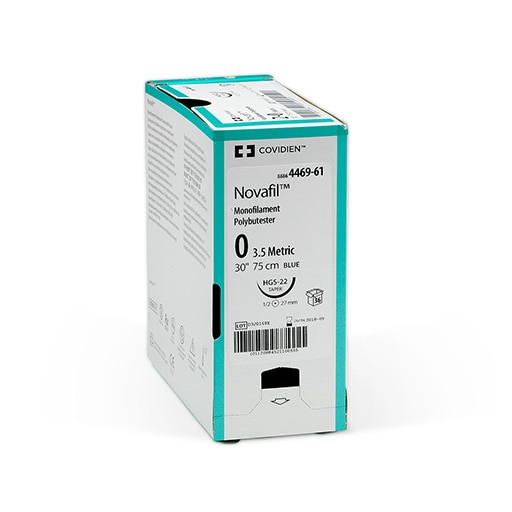
Both lines are polybutester monofilaments from Medtronic. This line adds the Polytribolate coating and concentrates on finer sizes in blue, while the sibling line is uncoated and spans a wider size range. Surgeons choose between them by coating preference and the size range the case requires.
How should sutures be stored?
Store sutures in their original packaging in a cool, dry place away from direct heat and light. Use stock in expiry order and do not use any suture whose package is opened or damaged, since sterility cannot be assured.
What do the suture size numbers mean?
USP suture sizes run from fine to heavy: more zeros mean a finer strand, so 7-0 is finer than 5-0, which is finer than 3-0. Sizes then rise through 0, 1, 2 and heavier for large tissue work. The variant label states the exact size of each configuration.
Can a suture be resterilized or reused?
No. These are sterile single use devices, and an opened or expired suture must be discarded. Resterilization is not permitted and compromises both sterility and material performance.