


Description
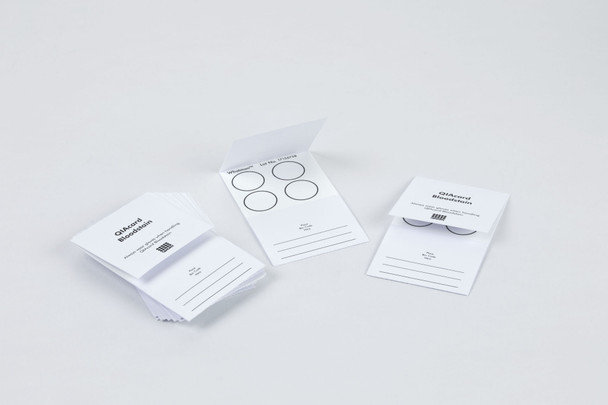
The Qiagen QIAcard Bloodstain Card is the untreated member of the family, a non-indicating card without FTA chemistry for collecting blood and bodily fluids for short term handling. A protective cover travels with the card, and the labeled card stores in a multi-barrier pouch with desiccant to keep the specimen dry.
- Untreated Matrix – No FTA coating, so the card suits workflows that need the sample without stabilization chemistry.
- Protective Cover – Each card includes a cover for convenient transport of blood and bodily fluids.
- Four Sample Areas – Four areas of up to 125 µL each organize multiple spots on one card.
About This Bloodstain Card
Not every collection wants the sample chemically stabilized, and that is the gap the Bloodstain format fills in this family. The manufacturer is explicit that, unlike FTA cards, this card carries no protective chemical cocktail, so bound DNA is at risk of degradation and damage over time. It is designed for collection and short term handling, not for long term archiving.
Collection follows the familiar card routine, with the sample applied to the areas and the cover closed for transport. The labeled card is placed in a multi-barrier pouch with a desiccant packet so the specimen stays dry in storage. Programs that process samples quickly, or that run methods incompatible with FTA chemistry, are the intended users.
Features and Benefits
Sample Handling
- Chemistry Free Collection – The untreated surface collects blood and bodily fluids without FTA reagents in the matrix.
- Cover Included – The protective cover shields the sample areas during transport and handling.
Laboratory Workflow
- Short Term by Design – The format targets prompt processing rather than archive storage.
- Pouch Storage – Cards store in a multi-barrier pouch with desiccant to keep specimens dry.
Product Specifications
Product Details
- Manufacturer: Qiagen
- Format: QIAcard Bloodstain, non-indicating, not FTA treated
- Sample Areas: 4 per card
- Maximum Volume: 125 µL per sample area
- Treatment: None, no FTA chemical coating
- Long-Term Storage: Not listed for long term storage
- Intended Use: Molecular biology applications, not for diagnostic procedures
Packaging
- Options: 100 cards per pack
- Handling: Process promptly after collection
Browse related categories: blood collection supplies and Qiagen products.
Why Choose This Bloodstain Card
Choosing the untreated card is a deliberate methods decision, made when FTA chemistry would interfere with the downstream process. This format keeps the familiar card handling while leaving the sample chemistry untouched.
- Method Compatibility – Workflows that cannot accept FTA reagents get a card from the same family and supply chain.
- Honest Handling Window – Short term positioning sets correct expectations, so samples are processed while quality holds.
- The Untreated Option – It is the only non-FTA card in the QIAcard lineup, a differentiator for methods that forbid stabilization chemistry.
Manuals and Troubleshooting Guides
Frequently Asked Questions
How is this card different from FTA cards?
This card has no FTA chemical coating, so it does not lyse cells or stabilize DNA the way FTA formats do. The manufacturer positions it for collection and short term handling of blood and bodily fluids.
How long can samples stay on the card?
The format is designed for short term handling, and the manufacturer does not list long term storage for it. Process samples promptly after collection.
What samples can be collected?
Blood and bodily fluids are the listed samples. Four areas each accept up to 125 µL.
How should the card be transported?
Close the protective cover included with the card. The manufacturer describes storing the labeled card in a multi-barrier pouch with a desiccant packet to keep the specimen dry.
Can DNA still be analyzed from it?
Direct STR amplification is listed for the format in the manufacturer comparison table. Quality depends on prompt processing because the sample is not chemically protected.
Is this card a diagnostic product?
No, that clinical role is outside the manufacturer stated molecular biology applications. It is not for the diagnosis, prevention or treatment of disease.