


Description
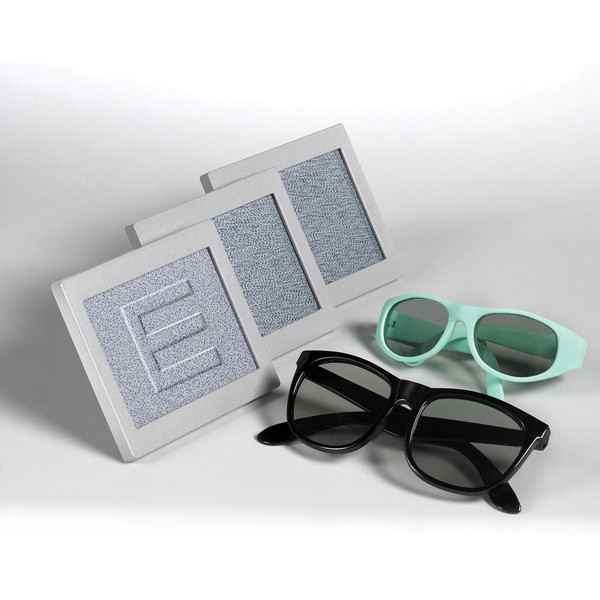
The Random Dot E Test screens depth perception by asking the patient to find the orientation of an E hidden in a random dot pattern. Because the E only appears through the stereo viewer glasses, the test works for children and adults who cannot rely on letter charts.
- True random dot target: The E is visible only with binocular fusion, with no monocular cues
- Viewer glasses included: Polarized viewers are part of the test set
- All-ages response: Pointing the E direction works for children and non-readers
- Card format: Sets up quickly on an exam lane or screening station
Stereo Screening That Does Not Depend on Letters
Random dot stereopsis is a strict test of binocular depth perception, because the target has no monocular cues to guess from. The patient wears the included viewer glasses and identifies which way the legs of the hidden E point. That simple response makes the test usable with young children, non-readers and patients who cannot manage a letter chart. The card format sets up in seconds on an exam lane or at a school screening station. Practices use it to document stereo function at baseline and follow-up visits.
Features and Benefits
- True random dot target: The E is visible only with binocular fusion, with no monocular cues
- Viewer glasses included: Polarized viewers are part of the test set
- All-ages response: Pointing the E direction works for children and non-readers
- Card format: Sets up quickly on an exam lane or screening station
Product Specifications
Test
- Type: Random dot stereopsis
- Target: Random Dot E orientation
Format
- Presentation: Test cards with viewer glasses
Product Details
- Manufacturer: Bernell Corporation
- Manufacturer SKU: VA1015
- Packaging: EA / 1
Explore more in Professional Use or Shop more Bernell.
Why Choose This Random Dot E Test
A stereo test that can be gamed by one eye is not measuring stereopsis. The random dot design removes monocular cues, and the pointing response keeps the test open to nearly every patient.
- No monocular shortcuts: The hidden E requires genuine binocular fusion to see
- Broad patient range: Children, non-readers and adults test on the same cards
- Fast screening: Card format suits lanes, schools and outreach screening
Frequently Asked Questions
Why a random dot pattern?
Random dot targets carry no monocular cues, so a correct answer proves the patient fused the images from both eyes.
Are glasses required?
Yes. The viewer glasses supplied with the test separate the two eyes' images so the E can appear in depth.
Can children take this test?
Yes. The patient only has to point which way the E faces, so pre-readers can be tested.
What does it measure?
It screens stereopsis, the binocular depth perception used for judging distance and position.
How is this product packaged?
It is sold in the manufacturer's standard packaging for the selected configuration, EA / 1, as shown in the product specifications.