


Description
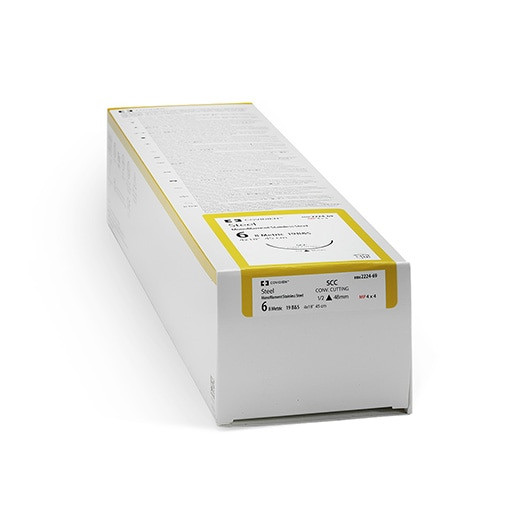
The Medtronic stainless steel suture is available from MedicalEx in the configurations listed below. The 316L stainless steel strand conforming to ASTM F138 is the most inert suture material available and delivers maximum tensile strength for closures under serious load.
- 316L stainless steel per ASTM F138 Grade 2
- Maximum tensile strength of any suture material
- Permanent, nonabsorbable support
- Sternal closure, hernia repair and cerclage indications
Browse the full Suture and Needles range, or shop everything from Medtronic.
Main Description
These sutures are composed of 316L stainless steel conforming to ASTM Standard F138 for stainless steel bar and wire for surgical implants. Steel is the most inert of all suture materials and provides maximum tensile strength, which is why it remains specified for high-load closures. Medtronic indicates the line for abdominal wound closure, intestinal anastomosis, hernia repair and sternal closure, and for certain orthopedic procedures such as cerclage and tendon repair. The strand is nonabsorbable with permanent tensile retention, in sizes 2-0 through 7 in this listing. Use is contraindicated in patients with known sensitivities to steel or its principal metallic components, chromium and nickel, and the presence of steel may interfere with certain radiodiagnostic procedures.
Features and Benefits
- Maximum strength – Steel outperforms every polymeric strand on tensile strength, the property sternal and fascial closures demand.
- Most inert material – Implant-grade 316L steel minimizes tissue reactivity among suture materials.
- Load bearing indications – Abdominal wall, hernia and sternal indications reflect closures where failure is not an option.
- Orthopedic utility – Cerclage and tendon repair configurations extend the line beyond general surgery.
Product Specifications
Material and Structure
| Composition | 316L stainless steel, ASTM F138 Grade 2 |
| Structure | Metal wire strand |
| Colors | Steel |
Performance and Use
| Tensile Strength | Permanent. Maximum among suture materials |
| Absorption Profile | Nonabsorbable |
| USP Sizes | 2-0 through 7 |
| Indications | Abdominal wound closure, intestinal anastomosis, hernia repair, sternal closure, cerclage and tendon repair |
Packaging and Configurations
| Sterility | Sterile, single use |
| Box Quantities | 1 or 3 dozen |
Product Line
| Brand | Medtronic |
| Product Family | stainless steel suture |
Distribution
| Availability | Continental US |
| Package Quantity | bx (per configuration as listed) |
Why Choose This Product
When a closure must simply not fail, surgeons still specify steel, and this line covers the sternal and abdominal sizes those sets require. Implant-grade material certification gives biomedical and quality teams a clean documentation trail.
- Strength ceiling – No synthetic strand matches steel's tensile ceiling. That is the entire reason for its continued use.
- Certified alloy – ASTM F138 conformance is a verifiable material standard, not a marketing claim.
- Cross-specialty – General, cardiothoracic and orthopedic sets all draw from this one family.
Frequently Asked Questions
Why use steel instead of a heavy synthetic?
Steel offers the highest tensile strength and the lowest reactivity of any suture material, which matters in sternal closure and high-tension abdominal or hernia repairs. Synthetics cannot match that strength ceiling.
Are there patients who should not receive steel sutures?
Yes. The line is contraindicated with known sensitivity to steel, chromium or nickel, and steel can interfere with some radiodiagnostic imaging, so the IFU should be checked for the planned follow-up care.
How should sutures be stored?
Store sutures in their original packaging in a cool, dry place away from direct heat and light. Use stock in expiry order and do not use any suture whose package is opened or damaged, since sterility cannot be assured.
What do the suture size numbers mean?
USP suture sizes run from fine to heavy: more zeros mean a finer strand, so 7-0 is finer than 5-0, which is finer than 3-0. Sizes then rise through 0, 1, 2 and heavier for large tissue work. The variant label states the exact size of each configuration.
Can a suture be resterilized or reused?
No. These are sterile single use devices, and an opened or expired suture must be discarded. Resterilization is not permitted and compromises both sterility and material performance.